At its peak in the 12th century, the Khmer Empire dominated most of mainland Southeast Asia and Angkor was home to nearly a million people — larger than any European city of the time.
1,000+
Temples
802–1431
AD
6
Centuries
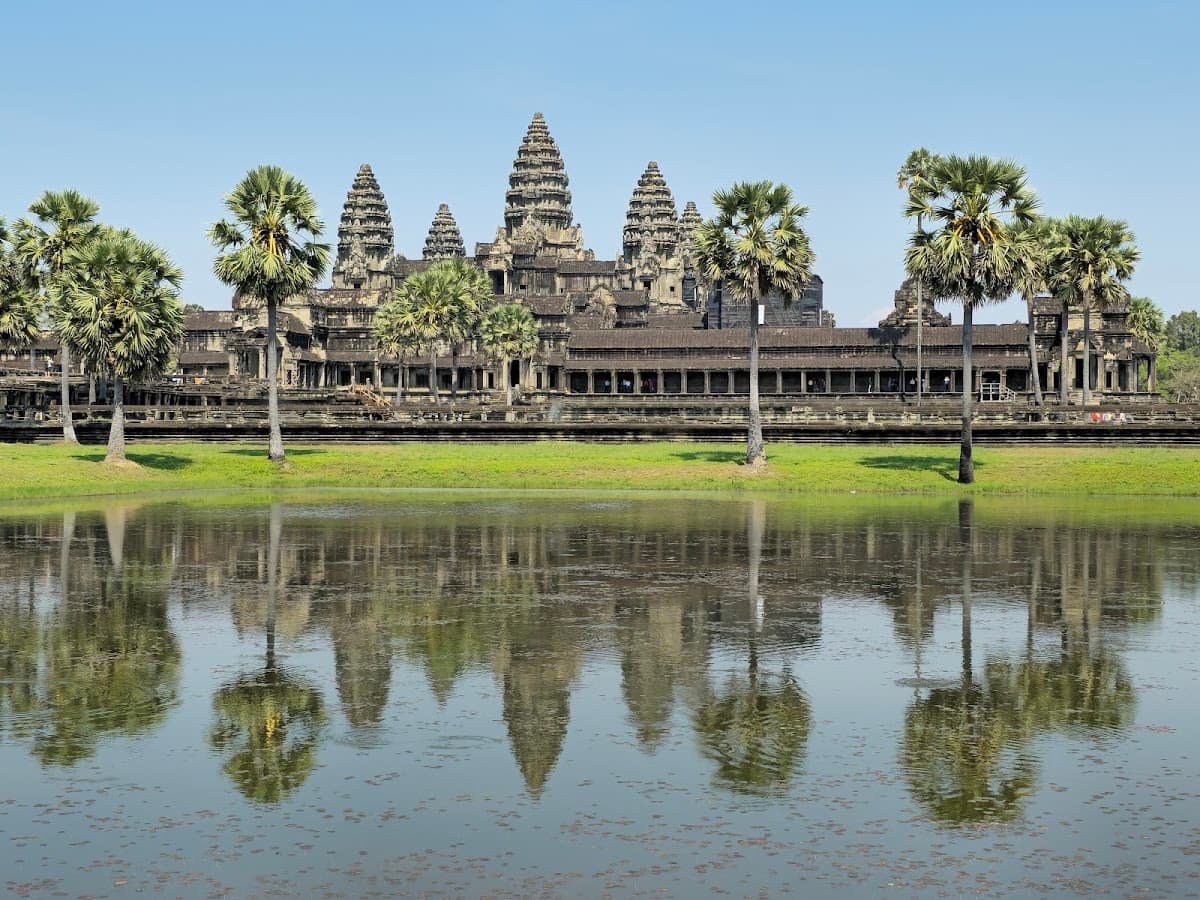
Angkor Wat — 12th century
The Angkor temples are not mere ancient ruins — they are the monumental legacy of a civilization that dominated Southeast Asia for more than six centuries. Between 802 and 1431 AD, the Khmer Empire built more than a thousand temples across an area larger than modern Paris, creating what archaeologists today consider the largest pre-industrial city in human history. To walk the corridors of Angkor Wat at dawn, or to stand beneath the 216 stone faces of the Bayon, is not simply to visit a tourist attraction — it is to enter a world that once rivaled the Roman Empire in scale and ambition. Here is the story of how that world was built, how it fell, and how it was rediscovered.
This guide traces the full arc of Angkor's history: from the founding of the Khmer Empire by Jayavarman II on the sacred mountain of Phnom Kulen, through the golden age of Suryavarman II and Jayavarman VII, to the mysterious decline and abandonment of the city in the 15th century. We explore the religious transformations, the engineering feats, the great kings, and the unsolved mysteries that continue to fascinate historians and archaeologists. Every fact in this article has been cross-referenced with academic sources and enriched by years of living near these temples in Siem Reap.
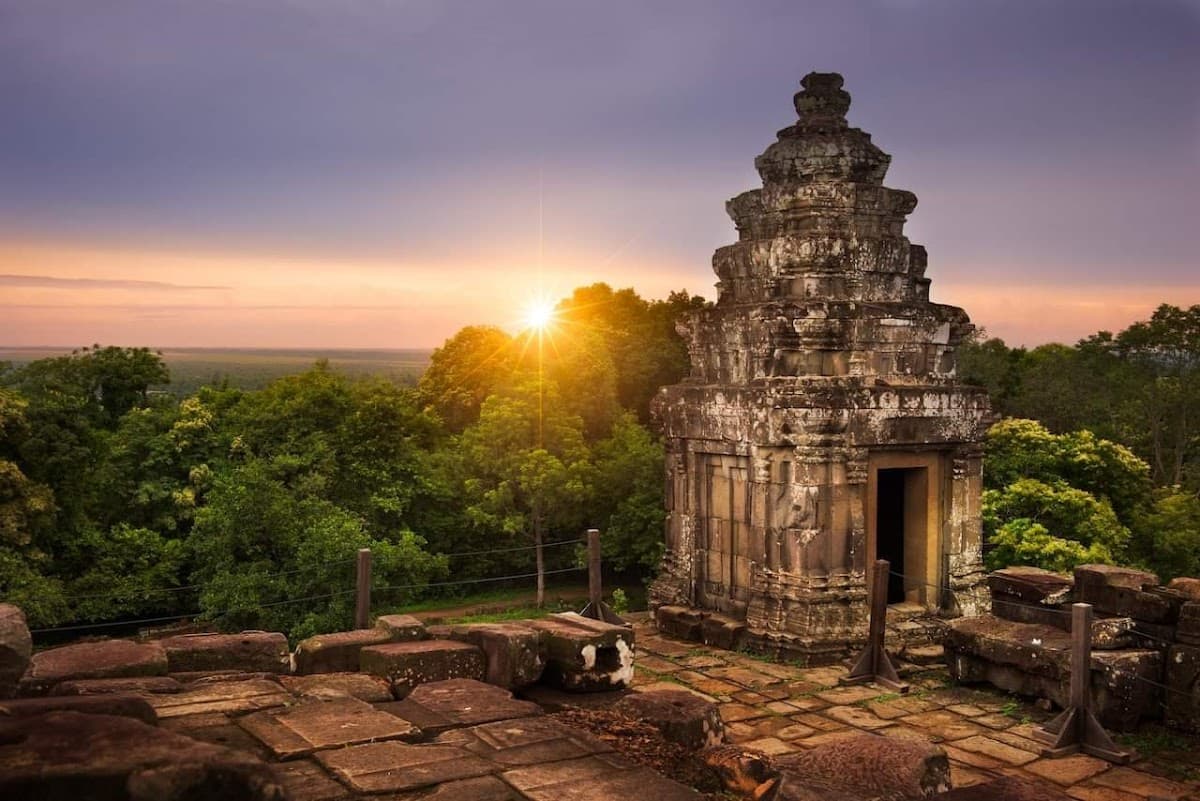
Timeline: 802–1431 AD
Angkor's history spans more than six centuries, from Jayavarman II's consecration as universal monarch (chakravartin) on Phnom Kulen in 802 to the sack of Angkor by the Siamese kingdom of Ayutthaya in 1431. In 802, Jayavarman II declared independence from the Javanese overlords who dominated the Khmer lands and founded the Khmer Empire with its capital near present-day Siem Reap. The devaraja ritual he performed on Phnom Kulen — consecrating him as god-king — is the founding act of an empire that would last six centuries.
In the 9th century, his successors began construction of the first great temple complexes at Roluos, including Bakong, Preah Ko, and Lolei, establishing the architectural vocabulary that would define Khmer art for generations: the sanctuary tower, the concentric enclosure, the axial causeway. Yasovarman I moved the capital to Angkor around 889 and built the East Baray, a massive reservoir 7.5 by 1.8 kilometers capable of storing more than 53 million cubic meters of water, ensuring irrigation for the rice paddies of the plain. He also built hermitages on every major hill in the region and founded the first temple of Angkor proper, Phnom Bakheng.
The 10th century saw intense dynastic rivalry and the construction of Pre Rup and East Mebon under Rajendravarman II, who also built Banteay Srei, considered the jewel of Khmer decorative sculpture. Suryavarman I extended the empire westward into present-day Thailand and built the West Baray in the early 11th century. The greatest period of construction came under Suryavarman II (1113–1150), builder of Angkor Wat, and Jayavarman VII (1181–1218), who in a single reign erected Angkor Thom, the Bayon, Ta Prohm, and Preah Khan — a stone output without parallel in pre-modern Asia.
After Jayavarman VII's death around 1218, the empire entered a slow decline marked by religious conflicts, environmental stress, and military pressure from the Thai kingdoms. In 1431, Angkor was largely abandoned and the royal court moved south, toward present-day Phnom Penh, better positioned for maritime trade.
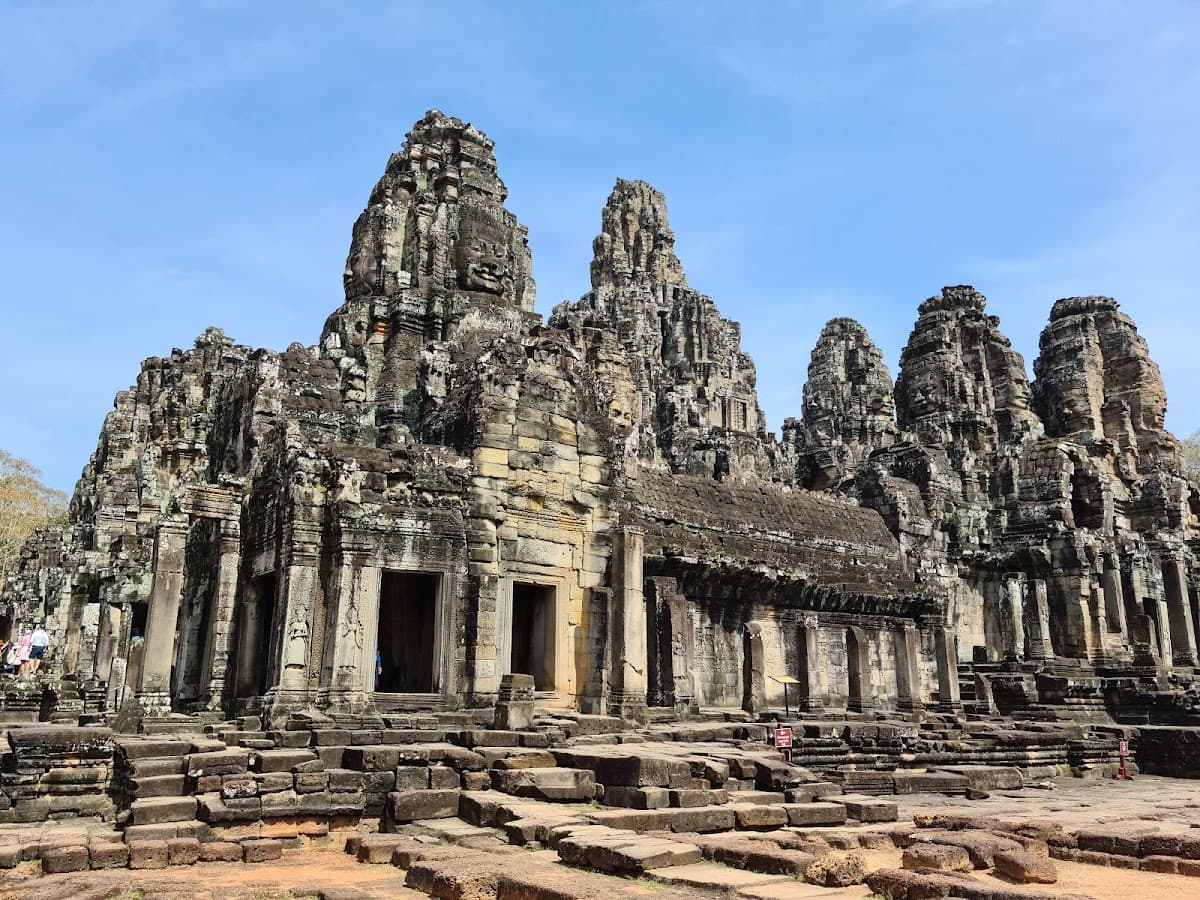
The great kings of Angkor
Three kings stand above all others in Angkor's history. Jayavarman II (802–835) founded the empire and introduced the cult of the devaraja — the concept of the god-king — that would define Khmer royalty for centuries. By performing the devaraja ritual on Phnom Kulen with the Brahmanic priest Sivakaivalya, he declared himself the earthly incarnation of Shiva, a theological assertion that legitimized his authority over all Khmer peoples and set the template for divine kingship for four centuries.
He unified the warring Khmer principalities scattered across the Mekong basin and established the sacred bond between king, gods, and land. His successors — Jayavarman III, Indravarman I, and Yasovarman I — each added temples, barays, and hydraulic infrastructure that grew the capital into the most sophisticated agrarian city in the pre-modern world. Suryavarman II (1113–1150) is the builder-king who commissioned Angkor Wat, the largest religious monument ever built by any civilization.
Dedicated to Vishnu and aligned with astronomical precision, Angkor Wat required roughly 30 years of construction and employed tens of thousands of artisans, sculptors, and laborers. Suryavarman II also pushed the empire to its maximum territorial extent, waging wars against the Cham kingdom of Champa to the east, the Dai Viet to the north, and the Mon kingdoms to the west. His naval campaigns on the Tonle Sap and Mekong attest to a military reach unmatched among his contemporaries.
Jayavarman VII (1181–1218) is considered by most historians the greatest Khmer king and certainly the most prolific builder. After the sack and occupation of Angkor by the Cham in 1177, he drove them out and rebuilt the empire on an unprecedented scale: Angkor Thom, the royal city encircled by 9 square kilometers of walls; the Bayon and its 216 enigmatic faces; Ta Prohm and Preah Khan as vast monastic universities; and a network of 102 hospitals. A devout Mahayana Buddhist, his entire program — from the Bayon faces to the temple-hospitals — reflects the ideal of universal compassion.
Angkor Wat in depth
Angkor Wat is not just a temple — it is a microcosm of the Hindu universe carved in sandstone and the most ambitious construction project in human history. Built by Suryavarman II between roughly 1113 and 1150, it is dedicated to Vishnu and oriented westward, which is unique among Khmer temples. This western orientation — associated with death and the setting sun in Hindu cosmology — leads scholars to debate whether it served as a funerary temple for the king.
The reading of bas-reliefs counterclockwise, the direction of Khmer funeral rites, reinforces this hypothesis. The temple covers 162.6 hectares, making it the largest religious monument on Earth, a record it still holds today. The central tower rises 65 meters and represents Mount Meru, the cosmic mountain at the center of Hindu and Buddhist cosmology.
The five towers, arranged in a quincunx, symbolize the five peaks of Mount Meru. The surrounding moats, 190 meters wide and nearly 5 kilometers in circumference, represent the cosmic ocean surrounding the mountain of the gods. A 250-meter sandstone causeway, flanked by stone nagas, crosses the moat and leads the pilgrim through a cruciform entry gallery before the inner temple reveals itself — an architectural procession designed to simulate the soul's journey toward the divine.
The 800-meter bas-relief gallery is perhaps the largest preserved narrative sculptural program from the ancient world: scenes from the Ramayana, the Mahabharata, historical battles of Suryavarman II, and the Churning of the Sea of Milk. The devata apsara — celestial female figures — appear in 1,796 individual carvings on the walls, each with a unique expression, hairstyle, or gesture. Recent LIDAR surveys by the Greater Angkor Project have revealed that Angkor Wat was surrounded by a vast precisely planned urban grid, invisible beneath the canopy for centuries.
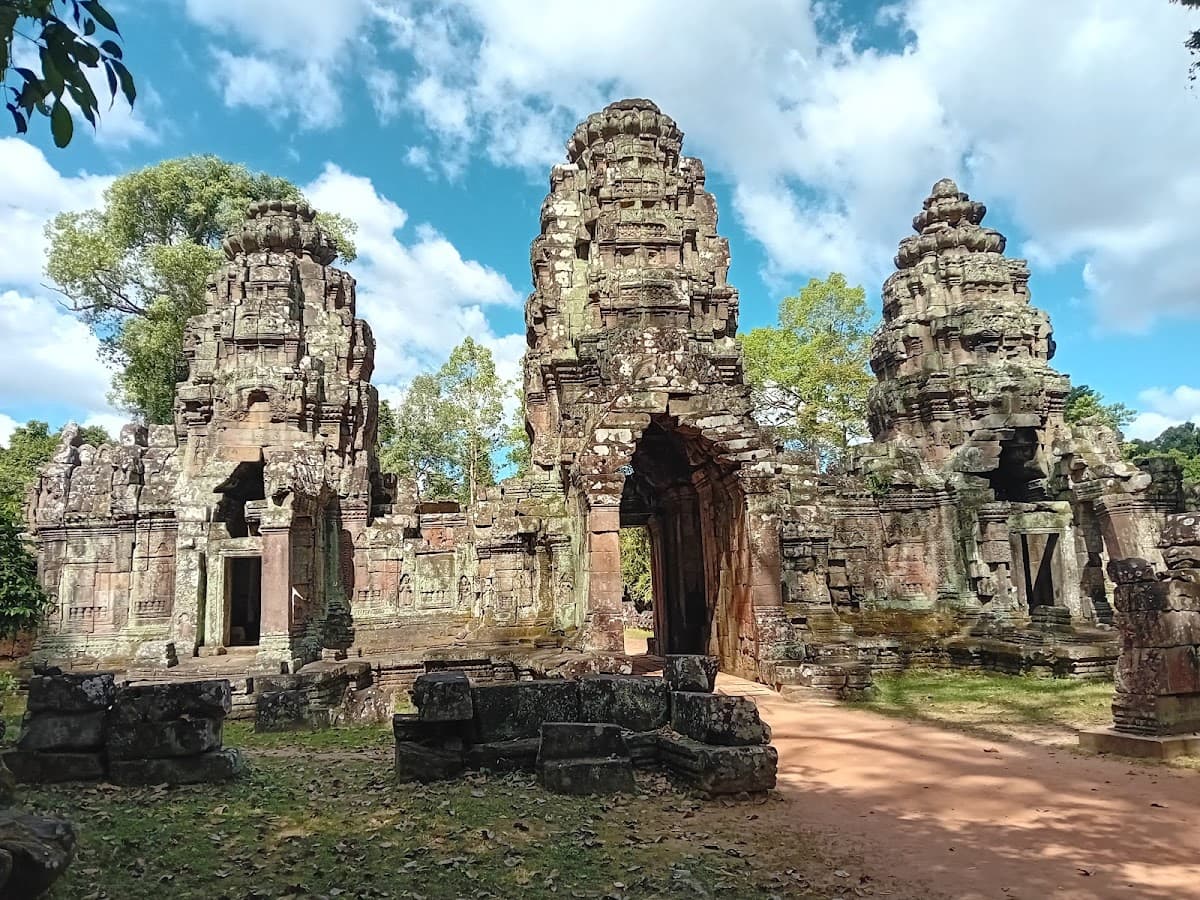
The hospital-temples of the Khmer Empire
One of the most remarkable and least-known aspects of the Khmer Empire was its systematic network of state hospitals — the first public health infrastructure in Southeast Asian history. Jayavarman VII, a devout Mahayana Buddhist who believed his subjects' suffering was his own, founded 102 hospitals (arogyasala) across the empire between 1181 and 1218. Each hospital was a small standardized temple complex built on an identical plan: a central sanctuary housing the image of Bhaisajyaguru, the Medicine Buddha; a laterite wall; a dharmasala (resting hall) for patients; and a basin for ritual purification.
The standardization itself is remarkable: it implies a centralized health administration capable of designing, funding, staffing, and supplying establishments across a territory covering present-day Cambodia, Thailand, and Laos. Inscriptions at Ta Prohm and Preah Khan indicate these hospitals each employed 80 to 100 people, including doctors trained in Ayurvedic medicine, nurses, cooks, and pharmacists responsible for medications. The hospitals were explicitly open to all regardless of caste, social status, or origin — a radical egalitarianism for the 12th century, prefiguring modern concepts of universal health coverage.
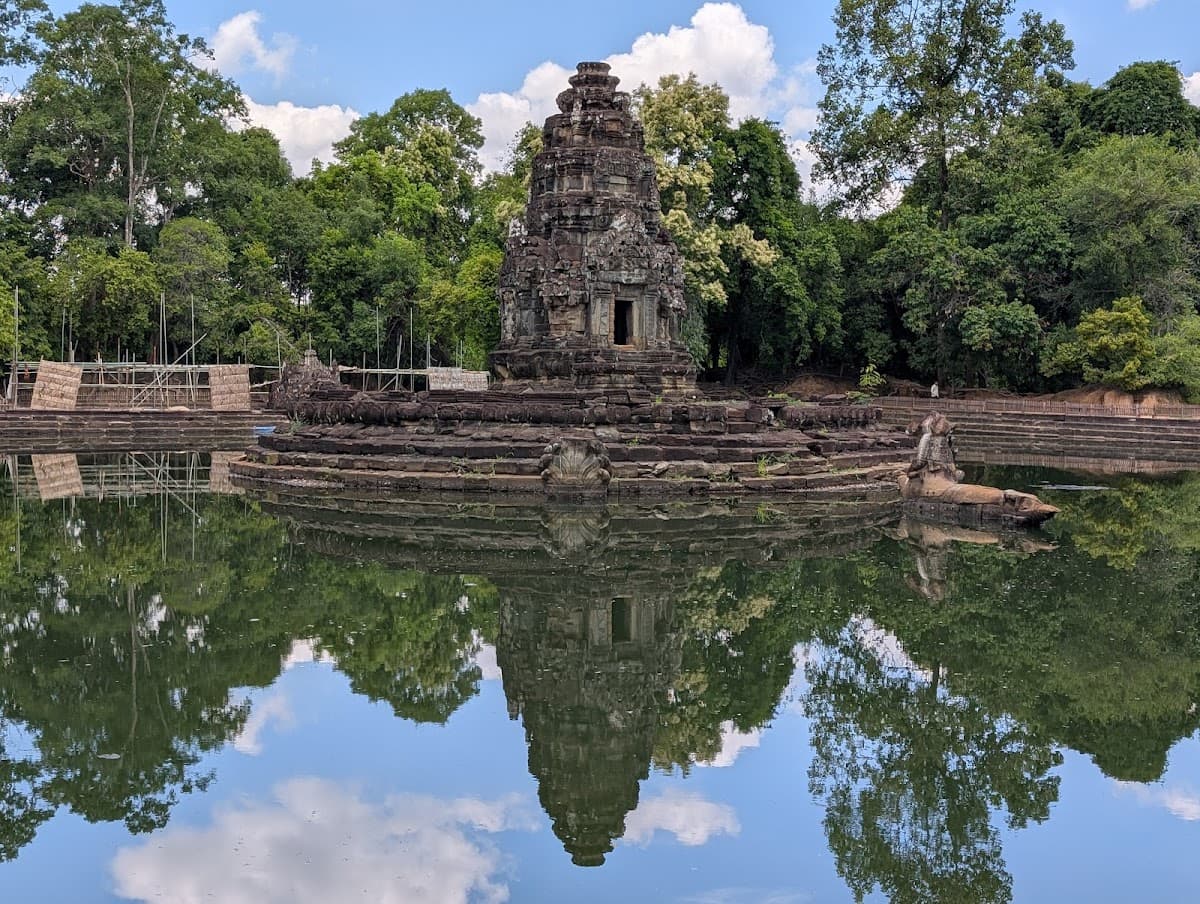
The pharmacopoeia recorded in the inscriptions included camphor, cardamom, ginger, honey, sesame oil, and dozens of other medicinal plants. Neak Poan, the island temple at the center of Jayavarman VII's Preah Khan baray, is interpreted by scholars as a spiritual healing complex where sacred water, believed to embody the curative properties of the mythical Lake Anavatapta of the Himalayas, flowed through four sculpted gargoyles into subsidiary basins. Pilgrims came from across the empire seeking cures, making Neak Poan the physical and spiritual heart of the Khmer healing world.
From Hinduism to Buddhism: the religious shift
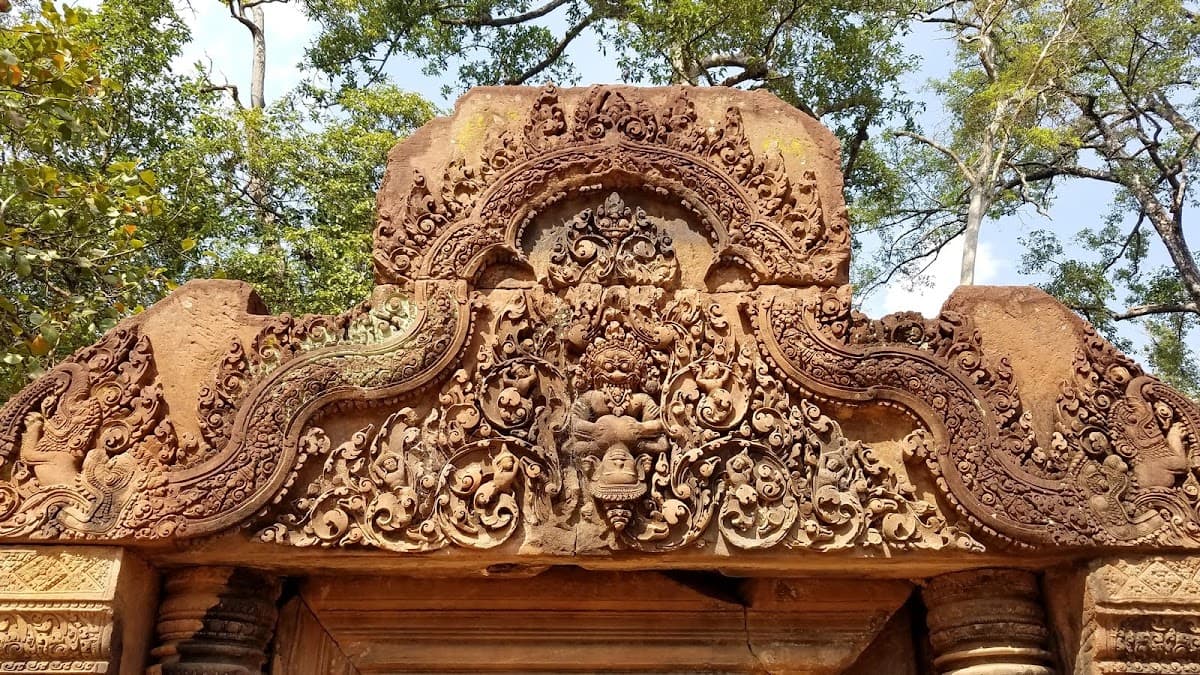
The Khmer Empire underwent one of the most dramatic religious transformations in Asian history, passing successively through three distinct state religions over six centuries. The early kings — from Jayavarman II in the 9th century to Suryavarman II in the 12th — were Hindu, primarily Shaivite, though Vaishnavism enjoyed royal patronage under Suryavarman II, who dedicated Angkor Wat to Vishnu. Their temples were designed as earthly representations of Mount Meru, the cosmic mountain at the center of the Hindu universe, and the kings themselves were considered living incarnations of the deities through the cult of the devaraja — a concept that fused Brahmanic ritual, Indian royal theory, and Khmer ancestor veneration into a uniquely Cambodian theological system.
The temple-mountain form, with its raised central prasat and concentric enclosures reproducing the rings of mountains and oceans surrounding Meru, is the direct architectural expression of this theology. The great turning point came with Jayavarman VII at the end of the 12th century. Having witnessed the catastrophic Cham invasion of 1177 — Angkor sacked and occupied for four years, King Tribhuvanadityavarman killed — he emerged as both military liberator and religious reformer, embracing Mahayana Buddhism.
The 216 serene faces of the Bayon are interpreted as Avalokiteshvara, the bodhisattva of compassion, superimposed onto the features of the king himself. After his death, a violent Hindu reaction took place under Jayavarman VIII (1243–1295), who systematically defaced thousands of Buddhist images across the empire — an ideological reversal still visible today in the chiseled-out Buddhas at the Bayon and Preah Khan. Then, in the 13th and 14th centuries, Theravada Buddhism — brought to the Khmer court by monks from Sri Lanka via the Thai kingdoms — gradually displaced Hinduism and Mahayana Buddhism.
This final shift fundamentally restructured Khmer society: the temple-building tradition ceased, the god-king concept was abandoned, and spiritual energy redirected toward wooden monasteries and personal merit accumulation — practices that still characterize Cambodian Buddhism today.
The fall of the Khmer Empire
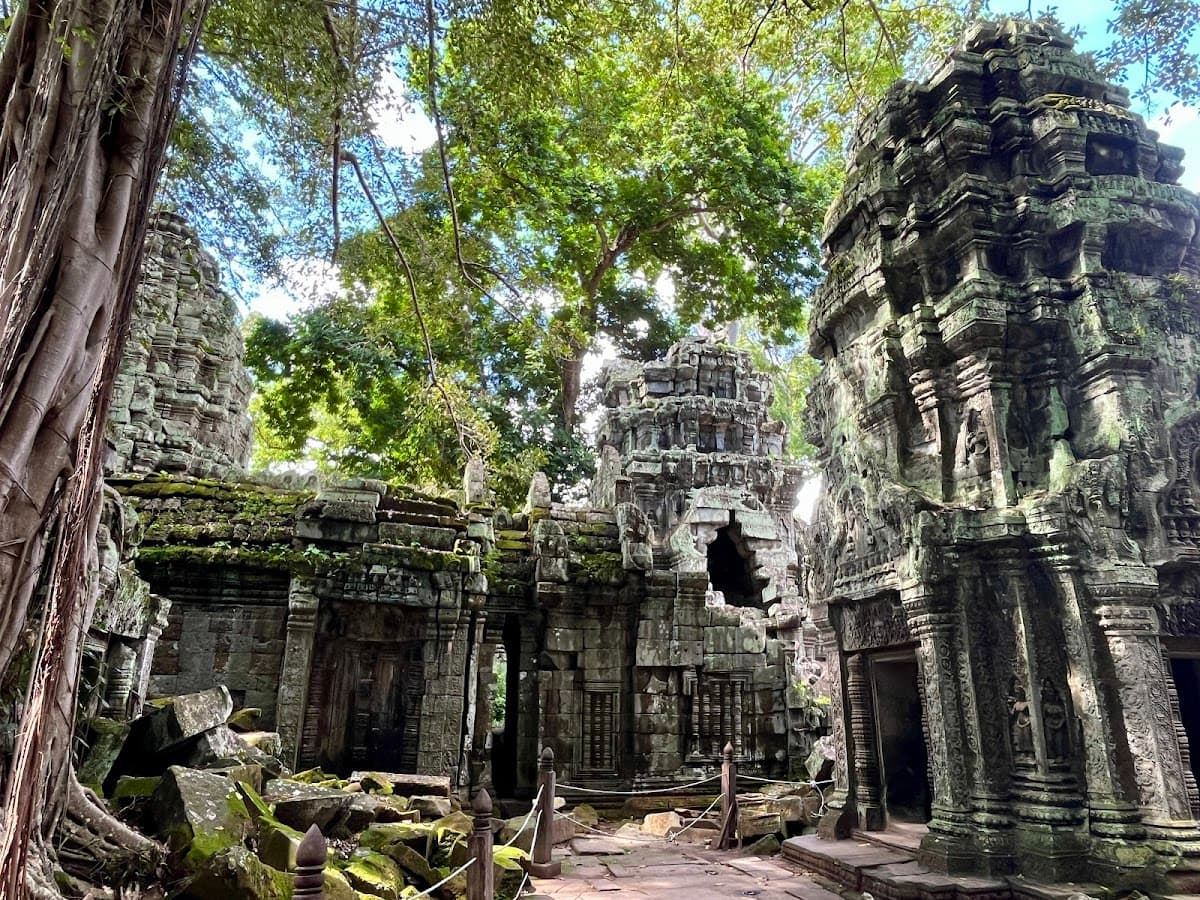
The decline of the Khmer Empire was not a sudden collapse but a gradual erosion over more than two centuries, driven by the interplay of forces no single king could have reversed. Historians have identified several factors, each amplifying the others. First, Jayavarman VII's massive construction programs may have pushed the empire's resources and manpower past the sustainable threshold.
The construction of Angkor Thom, the Bayon, Ta Prohm, Preah Khan, and over a hundred other structures in a single reign required sandstone quarried at Phnom Kulen, 50 kilometers away, cut into roughly 1.5-ton blocks and transported by a network of canals of extraordinary complexity. Inscriptions at Ta Prohm mention that this single temple required the labor of 79,365 people from 3,140 villages. Second, environmental degradation played a critical and increasingly well-documented role.
Pioneering research using airborne LIDAR combined with lake-sediment analysis shows that progressive deforestation of the Kulen Plateau — source of the rivers feeding the barays — combined with the silting of the canal network, led to catastrophic monsoon flooding and critical dry-season water shortages. By the 14th century, the hydraulic system that had made Angkor the rice basket of Southeast Asia, capable of producing three harvests a year, was fatally compromised. Third, the rise of the Thai kingdoms — Sukhothai first, then the more powerful Ayutthaya — exerted growing military pressure on the western frontier.
Ayutthaya sacked Angkor in 1351 and occupied it again in 1431, after which the Khmer court permanently abandoned the city and resettled around Phnom Penh, better positioned for river and maritime trade. Some historians also point to the ideological disruption caused by the spread of Theravada Buddhism, which challenged the god-king system that had justified the mobilization of collective labor on which the empire rested, as well as epidemics that may have caused significant demographic collapse.
Rediscovery by the West
Although Angkor was never truly forgotten by the Khmer people — monks maintained Angkor Wat as a functioning Buddhist sanctuary throughout the centuries of political decline, and the temple continued to draw pilgrims from across Southeast Asia — it was the French naturalist Henri Mouhot who brought the temples to sustained Western attention. Arriving in Cambodia in 1860 as part of a natural history expedition, Mouhot spent several weeks documenting the temples with remarkable precision, producing vivid written descriptions and pen-and-ink sketches published in Le Tour du Monde in 1863. The European public was electrified.
Yet the popular narrative of Mouhot as a solitary discoverer is a myth that history refutes. Portuguese missionaries and merchants had visited and described Angkor as early as the 1550s. The Spanish friar Marcelo de Ribadeneyra published a detailed description in 1601.
A Japanese Buddhist pilgrim named Kenryo Shimano produced a remarkably accurate floor plan of Angkor Wat around 1632, mistaking it for the sacred Jetavana grove. What Mouhot brought was not discovery but eloquent advocacy: his lyrical prose and dramatic sketches struck a European public hungry for tales of lost civilizations and transformed Angkor from a colonial curiosity into a cultural sensation. After his accounts — published posthumously after his death from fever in Laos in 1861 — sparked enduring European fascination, the French colonial administration responded swiftly.
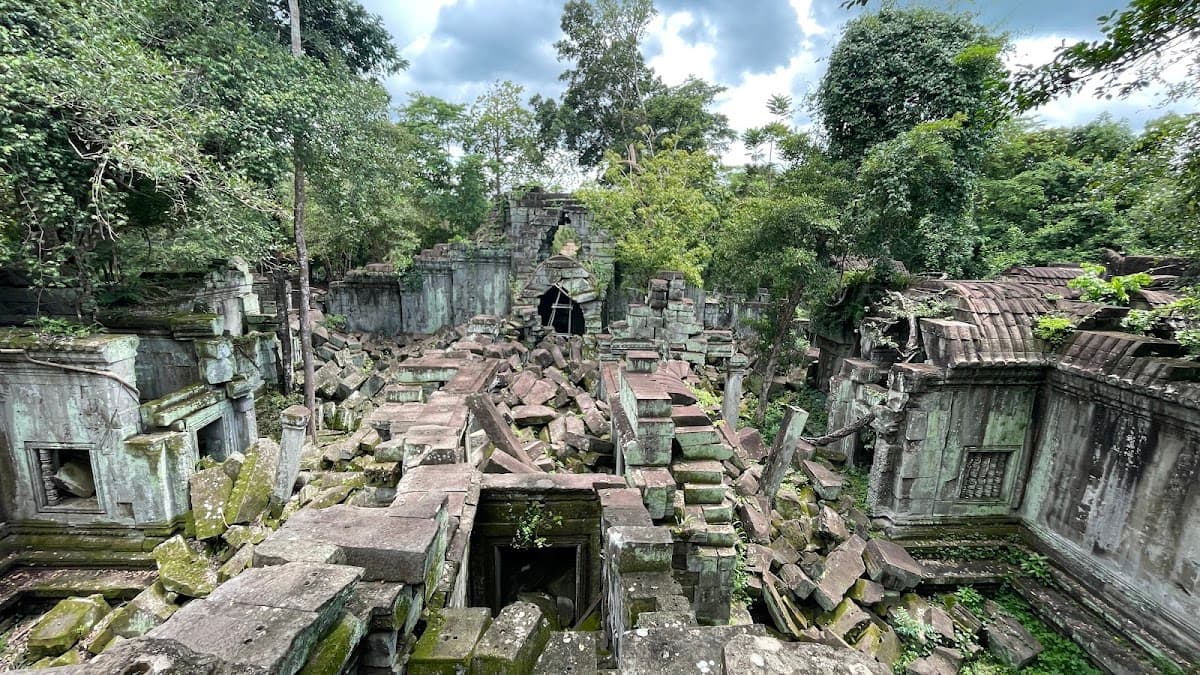
The École Française d'Extrême-Orient established a permanent research station at Angkor in 1901 and launched systematic archaeological surveys that catalogued hundreds of temples and produced the corpus of epigraphic translations still foundational today. The EFEO invented the technique of anastylosis — careful disassembly of collapsed structures stone by stone, cataloguing every block, then correctly reassembling them — applied iconically at Banteay Srei in the 1930s and to the Baphuon, a project interrupted by war and resumed over four decades. The 20th century brought extreme turbulence: the Khmer Rouge used Angkor Wat's silhouette as a propaganda symbol while looting many temples.
In 1992, UNESCO inscribed Angkor on the World Heritage list, catalyzing an international rescue effort engaging more than 20 nations.
Angkor's unsolved mysteries
Despite more than a century of dedicated research by archaeologists, epigraphers, art historians, and hydrologists from dozens of countries, Angkor preserves mysteries that resist resolution. The first and most debated is the western orientation of Angkor Wat. Practically every other major Khmer temple faces east — toward the rising sun and beginnings.
Angkor Wat faces west, toward the setting sun and, in Hindu cosmology, toward the realm of the dead. Some scholars argue this confirms its construction as a funerary monument for Suryavarman II, also drawing on the counterclockwise direction of the bas-relief program — the ritual direction of Khmer funerals. Others maintain the orientation was chosen for astronomical alignments: at the spring equinox, the sun rises precisely above the central tower as seen from the main causeway.
The debate remains open. The second great mystery is the identity of the Bayon faces. The 216 enormous stone faces gazing serenely from the 54 towers have been variously attributed by scholars to Avalokiteshvara, the four-faced god Brahma, Jayavarman VII himself depicted as a bodhisattva-king, or a deliberate theological fusion of all three.
No inscription names them definitively. A third mystery concerns the true scale of Angkor. Before the LIDAR revolution, scholars estimated the population at 200,000 to 300,000.
Airborne LIDAR surveys conducted since 2012 by the Greater Angkor Project have revealed a low-density urban landscape of up to 1,000 square kilometers — the size of Los Angeles — connected by roads, dikes, hydraulic infrastructure, and a network of pools. At its peak, some scholars estimate Angkor may have housed nearly a million people. A fourth unsolved problem is the reason for the failure of the hydraulic system.
LIDAR and sediment analyses show the system was modified multiple times, but whether its final failure was caused by mismanagement, extreme monsoon events, or structural problems remains unresolved. Dozens of temples have never been excavated and hundreds of inscriptions remain only partially translated.
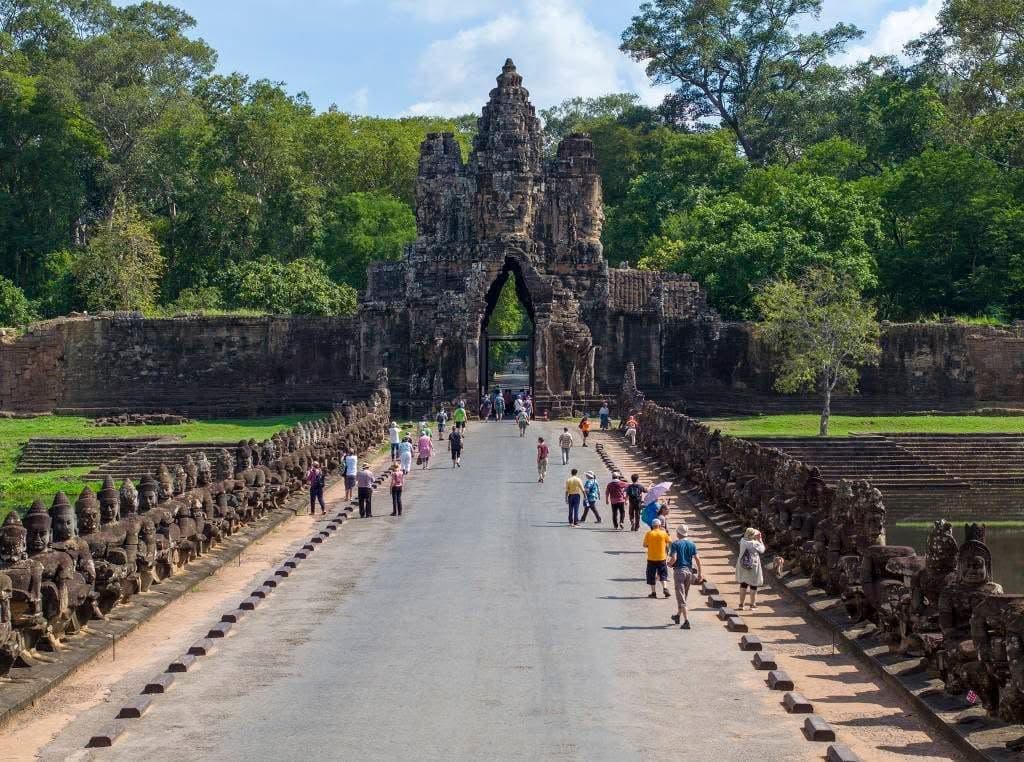
UNESCO World Heritage: from 1992 to today
Angkor was inscribed on the UNESCO World Heritage list in 1992, at a critical moment when Cambodia was emerging from two decades of devastating conflict and the temples faced existential threats: organized looting, uncontrolled encroachment, vegetation damage, and years of neglected structural maintenance. The inscription immediately placed Angkor on the World Heritage in Danger list, a designation that, far from being a mark of shame, served as a catalyst for one of the largest international conservation mobilizations in history. The International Coordinating Committee for the Safeguarding and Development of the Historic Site of Angkor (ICC-Angkor) was created in 1993 under the co-chairmanship of France and Japan, providing a multilateral governance structure bringing together donor countries, UNESCO, and the Cambodian government.
The results of the following decades were extraordinary. Japan funded the complete restoration of the Bayon and the North Library of Angkor Wat, employing teams of Japanese and Cambodian specialists for over a decade. France continued the EFEO's historic work on the Baphuon, a project interrupted by civil war and resumed under exceptionally difficult conditions because all the disassembly documentation had been destroyed by the Khmer Rouge.
India took on Ta Prohm. Germany worked on the Terrace of the Elephants. China restored Chau Say Tevoda.
The United States, through the World Monuments Fund, contributed to Preah Khan. In 2004, Angkor was removed from the World Heritage in Danger list. Today, the APSARA National Authority manages the 400-square-kilometer Angkor Archaeological Park, balancing the competing demands of conservation science, heritage interpretation, and a visitor flow that exceeded 2.6 million people before the pandemic.
New threats demand constant vigilance: groundwater depletion caused by Siem Reap's hotel proliferation has destabilized foundations in several temple zones, and accelerating climate change is speeding up the biochemical deterioration of sandstone carvings. Tourism management remains a central challenge: the concentration of 80% of visitors at a handful of major sites creates extreme pressure on those monuments.
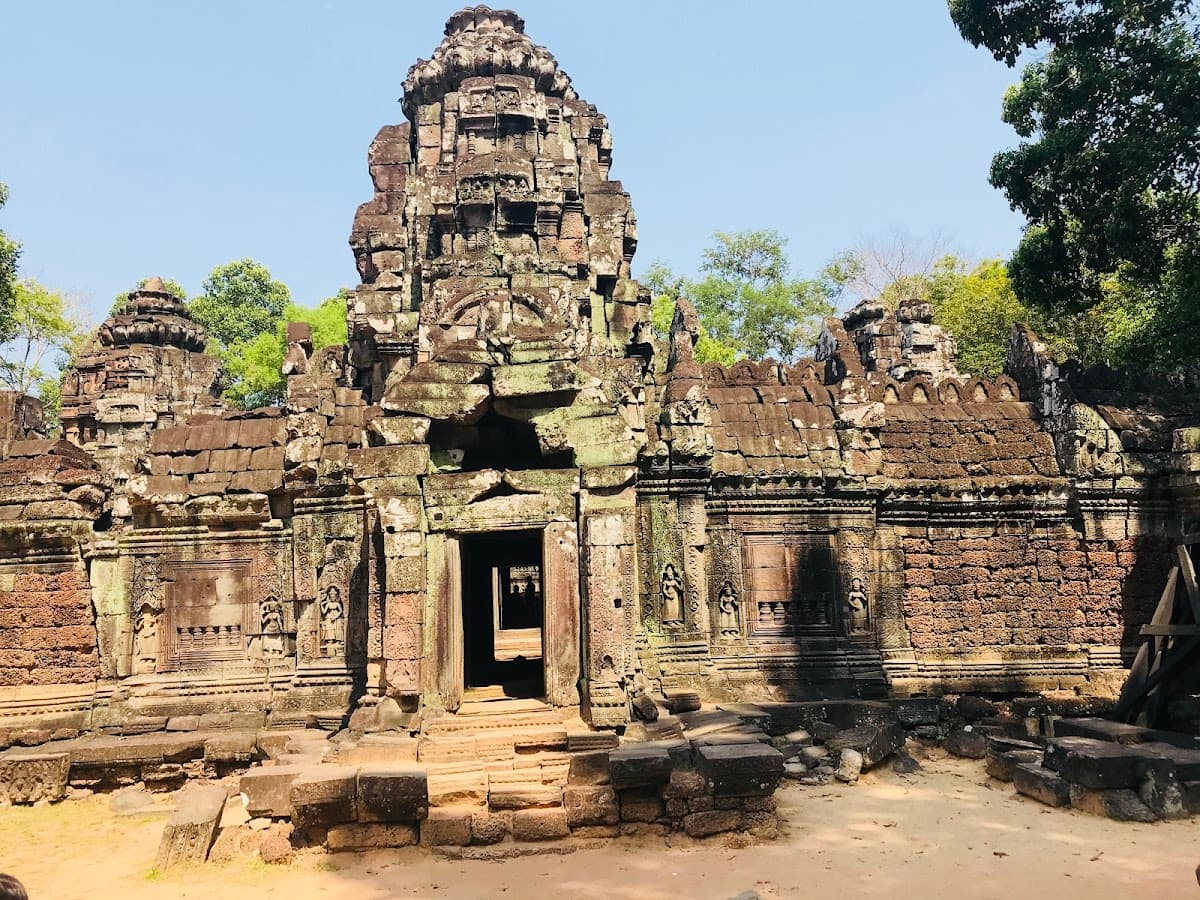
Angkor's living legacy
Angkor is not a dead city — it is a living symbol of Khmer identity that pervades every dimension of modern Cambodian culture, from state symbols to daily spiritual practice. The silhouette of Angkor Wat appears on the national flag — the only national flag in the world to depict a building — as well as on the riel banknote, the national beer label, and countless commercial logos. This ubiquity is no accident: Angkor is the founding evidence of Cambodian civilizational greatness, a counterpoint to the 20th-century trauma every Cambodian carries within.
Classical Apsara dance, whose origins trace to the devata and apsara figures carved with extraordinary delicacy on the walls of Angkor Wat and Banteay Srei, was nearly exterminated by the Khmer Rouge, who killed roughly 90% of Cambodia's professional artists between 1975 and 1979. The art was revived after liberation by a generation of survivors who had hidden their knowledge, and officially recognized as UNESCO intangible cultural heritage in 2003. It is performed every evening in Siem Reap, keeping alive a tradition more than a thousand years old and providing economic livelihood to hundreds of Cambodian artists.
The Khmer language and its script — the oldest continuously used writing system in Southeast Asia, predating the Thai and Lao scripts by several centuries — evolved directly from the Old Khmer Sanskrit inscribed on the lintels and stelae of the empire. Modern Cambodian Buddhism retains unmistakable traces of the Hindu-Buddhist syncretism of the Angkorian period: nagas guard pagoda stairs, Vishnu appears alongside the Buddha in temple iconography, and the Khmer New Year preserves the cosmological symbolism rooted in the empire's Brahmanic worldview. For the residents of Siem Reap, the temples are living sacred spaces where families arrive before dawn to make offerings of jasmine and lotus, where saffron-robed monks chant in the same galleries that once rang with Sanskrit hymns, and where Cambodians celebrate Pchum Ben by leaving food at temple gates for the souls of the spirit world.
To live near these temples is to understand that Angkor is not in the past. It is in the present, renewed every day.
Frequently asked questions
When was Angkor built?
The Khmer Empire founded Angkor in 802 AD when Jayavarman II declared himself universal monarch on Phnom Kulen. Construction of the great temples continued until the early 13th century. The city was largely abandoned in 1431.
Who built Angkor Wat?
King Suryavarman II commissioned Angkor Wat between roughly 1113 and 1150. It was originally a Hindu temple dedicated to Vishnu, later converted to Buddhism.
Why was Angkor abandoned?
Angkor was abandoned due to a combination of factors: environmental degradation of the hydraulic system, exhaustion linked to the construction programs, military pressure from the Thai kingdom of Ayutthaya, the shift to Theravada Buddhism, and possibly epidemics. The Siamese sacked Angkor in 1431.
How many temples are there at Angkor?
There are more than 1,000 temples and structures in the Angkor Archaeological Park, which covers more than 400 square kilometers. Only a fraction is open to visitors, with about 30 major temples commonly visited.
Is Angkor Wat Hindu or Buddhist?
Angkor Wat was originally built as a Hindu temple dedicated to Vishnu in the 12th century. It was gradually converted to Theravada Buddhism in the 13th–14th centuries, which it remains today.
What do the Bayon faces represent?
The 216 stone faces on the Bayon's 54 towers are believed to represent Avalokiteshvara, the bodhisattva of compassion, possibly combined with the face of King Jayavarman VII. Scholars continue to debate the exact meaning.
Who was Jayavarman VII?
Jayavarman VII (reigned 1181–1218) is considered the greatest Khmer king. A devout Buddhist, he rebuilt the empire after the 1177 Cham invasion, built Angkor Thom, the Bayon, Ta Prohm, Preah Khan, and founded 102 hospitals across the empire.
How was Angkor rediscovered?
Angkor was never truly lost to the Khmer people. French naturalist Henri Mouhot brought it to Western attention in 1860 with his published sketches and accounts. Portuguese missionaries had visited it as early as the 16th century.
When did Angkor become a UNESCO site?
Angkor was inscribed on the UNESCO World Heritage list in 1992. It was first placed on the heritage in danger list, then removed in 2004 after significant conservation progress.
How big was the Khmer Empire?
At its peak under Jayavarman VII at the end of the 12th century, the Khmer Empire controlled most of mainland Southeast Asia, including present-day Cambodia, Thailand, Laos, and southern Vietnam. Angkor may have housed up to a million people.
Why is Angkor Wat on the Cambodian flag?
Angkor Wat has appeared on the Cambodian flag since 1850, making it the only building on a national flag in the world. It symbolizes Khmer identity, civilizational achievement, and national pride.
What happened to Angkor during the Khmer Rouge?
During the Khmer Rouge regime (1975–1979), Angkor served as propaganda but also suffered looting and neglect. Temples were damaged and statues decapitated or stolen. International conservation efforts after 1992 have repaired much of the damage.
What is the baray hydraulic system?
The barays were enormous artificial reservoirs built to store monsoon water for dry-season irrigation. The West Baray measures 8 by 2.3 kilometers and still holds water today. This hydraulic system was the foundation of Angkor's agricultural productivity and urban population.
Can you visit all 1,000 temples?
No. Most of the 1,000+ structures are unrestored ruins deep in the jungle. The standard Angkor Pass covers about 30 major temples. Remote sites like Beng Mealea and Koh Ker require separate access or are included depending on the ticket type.
What did LIDAR reveal about Angkor?
LIDAR surveys conducted since 2012 have revealed that Angkor was far larger than previously thought — a sprawling low-density urban landscape of up to 1,000 square kilometers with roads, canals, pools, and residential areas hidden beneath the canopy. This has fundamentally changed our understanding of the Khmer Empire.
Published by Siem Reap Hub
The community guide for expats and travelers in Siem Reap, Cambodia.
Built by a French engineer based in Siem Reap since 2025, combining AI analysis (Claude, RAG pipelines) and Google Maps data to build the most complete local directory — 5,300+ verified businesses. No sponsored placements, no paid content.